Showing posts with label anthony zimba. Show all posts

Friday, November 30, 2012

Should epileptics be allowed to drive?

By Meluse Kapatamoyo

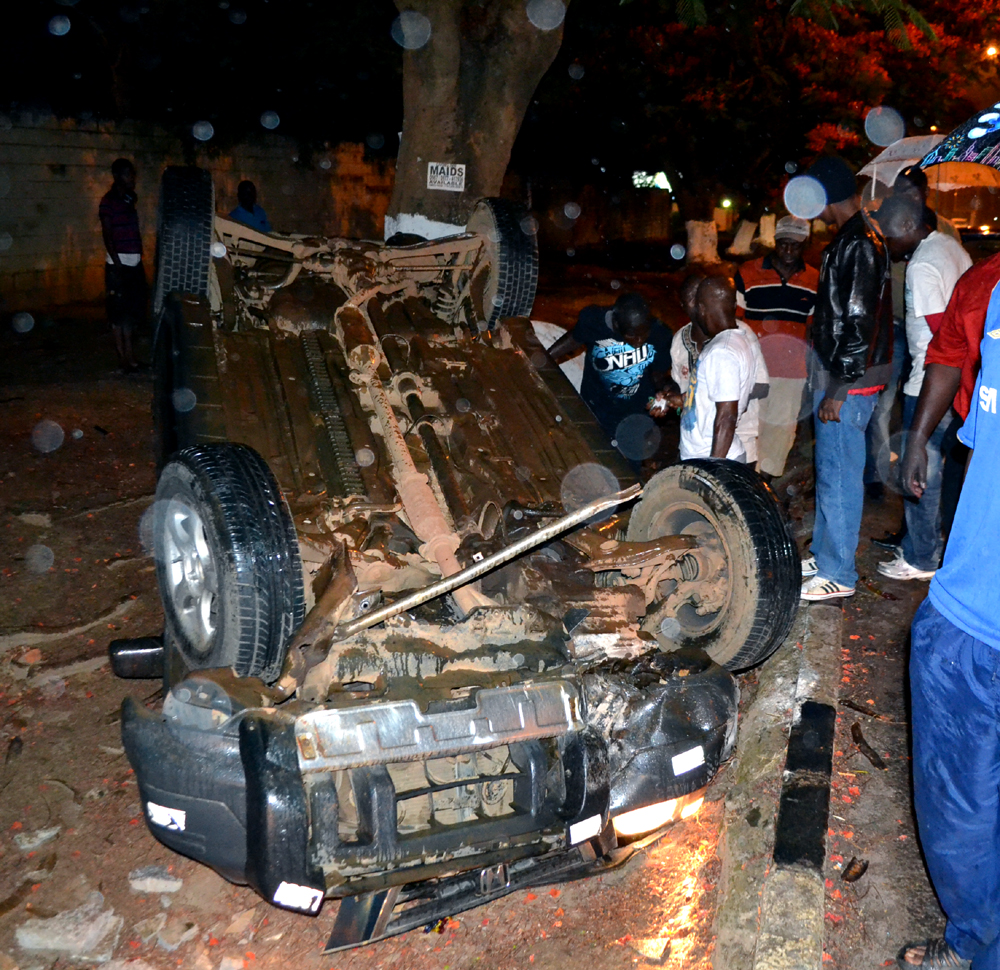
Should epileptics be allowed to drive? That was the question onlookers at the scene of a recent accident in Lusaka asked as they stood by and watched a motorist who had had a seizure behind the wheel ram into another car.

The more conscientious among the bystanders helped him out of the car he was driving and laid him on the floor next to a hardware shop as he twitched and foamed at the mouth.

Thankfully, no –one was injured in the accident and the driver of the care he had hit into made a compassionate decision not to press charges.

But his decision did not absolve the epileptic motorist from blame for driving when the unpredictability of his condition posed a risk to him and a greater risk to motorists and pedestrians alike.

But Epilepsy Association of Zambia president Anthony Zimba has a different point of view about whether or not those who suffer seizures should be licensed to drive.

EAZ President Anthony Zimba
He says frequency of the seizures, epileptic or non- epileptic, what time they come and whether the patient is on medication or not, determines whether the patient should get behind the wheel. 

“If someone has active seizures, meaning they are frequent and come during the day and that person is on medication, such people are not supposed to drive. But if the seizures only come at night, we may have a discretion and allow that person to drive,” he explained.

People, whose seizures are irregular and only come once a year or once every six months, can also be given a go-ahead by medical practitioners to get on the road. But, they can only drive light vehicles and not passenger vehicles such as mini-buses or trucks.

People with irregular seizures and not on medication, should not drive.
RTSA has recorded 600 deaths in the third quarter of 2012
However, while these precautions can mean life or death, for the driver and other road users, these are not laws. Health practitioners can only advice. The final decision is with the patient who has the right to decide whether to drive or not. Unfortunately, many get on the road.

Mr Zimba said, “If there were regulations, which we do not have in this country, in a situation as the one at Millennium Bus stop, if it’s confirmed epilepsy, that persons licence can be suspended until such a time when the seizures have stopped completely and they have been on treatment for two and half years. Only then can their licence be lifted. With any laws, all we can do is for now is plead with our patients not to drive, some do, but because the majority of people hide their condition even from employers, they end up driving.”

Zambia is one of the many countries in Africa that have no regulations for persons with epilepsy or seizures. But, countries like South Africa have formulated some guidelines.

According to the South African National Road Traffic Act, you are not permitted to drive if you have uncontrolled epilepsy. Nonetheless, they too have left the final decision of whether to drive or not to the individual concerned and their health doctor.

In addition, Epilepsy South Africa, has formulated the following guidelines for people with epilepsy; if you change or stop your medication suddenly, stop driving until your doctor advises it’s safe to do so. If you have a seizure for the first time in years, stop driving and consult your doctor. Don’t drive when you’re tired, stressed or ill, as you’re more likely to have a seizure at such time. Never drink and drive.

Unfortunately, ‘epilepsy can happen anywhere and at anytime,’ early this year, a man was killed when he crashed into a primary school in SAs Cape Town, apparently while suffering an epileptic seizure. Two children were also injured.

The incident drew a lot of national interest, with condolence messages going to the deceased family and speedy recovery messages to the two kids who were injured. Concerns were also raised as to whether the man should have been driving given his condition.

In the United Kingdom, the Driver and Vehicle Licensing Agency (DVLA) is the condition that licenses cars and drivers for driving on public roads. Its guidelines say if you have a driving licence, by law it is your duty to tell the DVLA about any medical condition which may affect your ability to drive, including epilepsy. This is a condition of holding a driving licence.

According to the Epilepsy Society, “if you have a driving licence, and have a seizure of any kind, the DVLA regulations say that you must stop driving. You are responsible for telling the DVLA and returning your licence to them.

“The regulations cover all epileptic seizures: auras and warning, seizures where you are conscious, myoclonic jerks, and seizures where you lose consciousness.”

In Zambia, every expectant driver must conduct a medical test for audio and visual capacities, where obvious disabilities are also noted, Road Traffic and Safety Agency (RTSA) Principal Publicity Officer says, “Problems such as epileptics cannot be diagnosed, unless the person reveals on their own that they suffer from this condition. And then evidently RTSA would not give a license because such a disease is not planned for any attack.”

Conducting drivers test involves a theoretical test that requires knowledge o the Highway Code involves a practical test that requires ones skills such as reversing, turning right, left and simply propelling the vehicles. Road skills such as getting into the reality of driving where there is traffic are also conducted with a RTSA examiner.

“I am not sure what type of machines can determine someone's driving skills except to have tests that take the drivers on the road and they are practically tested by examiners. RTSA has never recorded or received any reports of seizures as causes of accidents on the road,” said Khozi.

The agency recorded 8, 801 accidents, in the third quarter of 2012, that  led to 600 deaths.PYM 


Monday, July 16, 2012

Epilepsy: Anytime Anywhere – Be prepared


Chishala Mumba

By Meluse Kapatamoyo

Mental health illnesses remain one of the most misunderstood health conditions among many (African) communities and Zambia is no exception.
A neurological condition, Epilepsy (aka a seizure disorder), which affects the nervous system can be best explained by Chishala Mumba, 20, an Environmental Health Technology student at Lusaka’s Chainama College of Health Sciences who has experienced it firsthand.

“I started having seizures in 2005 and the doctors couldn’t come up with a proper diagnosis. It was irritating because I was limited on how happy or upset i could be because excessive happiness or sadness are said to trigger seizures.

Since then I have experienced a lot of scary moments. One time i was leading worship during fellowship, all of a sudden I felt a sharp pain in my spine, and was rushed to the hospital.  There, i was immediately put on oxygen because i couldn’t breathe. Ten minutes later the tank ran out and the nurses had to go in search of another.

I live in fear. For example, I was scared of having an attack when I went for a boat cruise on Lake Kariba. One of the most disturbing things I heard when I started to have seizures was when a certain doctor told me that I would not be able to get married or live far from home. But here i am living in Lusaka which is hundreds of kilometres from Kitwe where I am from.

Yes i have had challenges here too, like the time i had my first seizure at school and i had to break the news to my roommate. Luckily, she understood because she also had a rheumatic heart condition and we both needed to know what to do in the event that either one of us had an attack.

I am lucky that I have never had a seizure among strangers, during the times i have had the attack, people around me have been amazingly caring. They make sure that i have enough air and if i take long to regain consciousness, they rush me to the clinic.

But i know that people’s perception of the condition can be very negative. Some fear that they may contract epilepsy especially from those who have discharges from the mouth or pass urine when under attack, which fortunately i never do.

However, being a student at Chainama has not only helped me with access good medical services but it has also given me the chance to meet people with the same condition and hear about their challenges, as well as how society reacts to them. I appreciate the support from my family and friends during the times I get sick.”

As can be deduced from this story, the impact of epilepsy is not only on the person with the condition and the family but is also felt by the community because of the unpredictability of the seizures which can occur anytime and anywhere, and without warning.

But according to experts, if the patient is able to identify factors that trigger their seizures, they can help themselves a great deal by trying to avoid those things as much as possible. One way to identify the factors is by keeping a seizure calendar or diary.

In simple terms, Epilepsy can be defined as having recurrent seizures (convulsions) which are unprovoked. These are episodes of disturbed brain activity that cause changes in attention or behaviour.

The World Health Organisation (WHO) estimates that there are over 50 million epilepsy sufferers in the world today, with 85 percent living in developing countries.

In Zambia, although no epidemiology or study has been done to find out the extent of the burden of epilepsy, from hospital records, the prevalence is very high, says Anthony Zimba, who is Epilepsy Association of Zambia president and also International Bureau of Epilepsy (IBE) Africa region vice president.

Just like there are different types of seizures, not all seizures are epileptic.

And according to Mr Zimba, the management of epilepsy can take approximately two years. Only after two years and without experiencing seizures, can doctors recommend a reduction in dosage, which can last up to six months.  And if the condition remains the unchanged, the patient can then be declared free of epilepsy.

He expressed concern that in Zambia, there was a general lack of knowledge on how best to look after epilepsy patients whenever they had an attack because people had the tendency to panic.  The panic, he said, resulted in them using wrong methods of care which put the lives of patients at risk.

Mr Zimba gave the following tips as measures one should take when caring for someone having an epileptic attack, emphasising that the golden rule to remember was ‘You cannot stop someone from having a seizure.’

“Do not shake or hold a person who is having a seizure. Instead, get a soft cloth and place it underneath the patients head to protect them from injuries and then proceed to remove any hazardous objects,” he explained.

Loosen tight clothes such as shirt collars, or if someone wears glasses, remove them. If that person was eating you must open their mouth and remove the food but be very careful because they can bite you.

But while it a common trend to put a stick or spatula in the mouth of the person having a fit to protect them from biting their tongue, Mr Zimba said doing so introduces infection and may lead to the person breaking their teeth, emphasising “People do not swallow their tongues during a seizure. A bitten tongue can heal, but by placing objects you risk breaking their teeth and can even introduce infection.”

He also warned against rolling the person to the side while they were having a seizure. But once the seizure had stopped, the person could be rolled to the side to allow any vomit or saliva to drew down and avoid chocking.

However, in instances where the person having a seizure goes into a kind of altered state of consciousness for a short period of time (the person may look dazed and stare into space), it is enough to stay by the person and wait for the seizure to pass. After they have regained consciousness, he/she may be dazed so it is vital that you remain calm and reassuring. Do not talk in a harsh tone as this can scare them.

“But what in many instances what people do is that the moment they people see a person having a seizure, they lift them, put them into a taxi and rush them to the hospital. That is very unnecessary unless a fit lasts more than 10 minutes. Then it becomes a hospital emergency. One has to be put on IV line or injected with medicine to stop the seizure,” stressed Mr Zimba.

Chishala on a cruise on Lake Kariba


He said only under the following circumstances should a person having a seizure be rushed to the hospital; If the person is pregnant or if they have injured themselves or if that individual is diabetic or suffers from a condition which can worsen the seizure.

And if while having a seizure, the individual fell into a pool or river and had gotten chocked, they should be rushed to the hospital. This also includes anyone who fails to regain consciousness or is not breathing normally.

“Most importantly if that individual is having a seizure for the first time. They need to be taken to the hospital to investigate the cause and also rule out infections or other problems,” said Mr Zimba.