Showing posts with label alliance zambia. Show all posts

Monday, December 17, 2012

My World AIDS Day commemoration with Alliance Zambia

BY MELUSE KAPATAMOYO

For most people, the commemoration of World AIDS Day (WAD) which falls on December 1 each year entails march pasts and listening to speeches filled with frightening statistics on the high levels of HIV, I celebrated the day with staff at Alliance for Community Action on HIV and AIDS (Alliance Zambia) who observed the day in a unique way by sharing their personal experiences with and about the disease.

The organisation which deliberately commemorated WAD on December 3, 2012 so as to coincide with World Disability Day also saw staff spend part of their afternoon visiting Cheshire Homes for the Disabled in Kabulonga where they donated baby caps and clothing to care-givers.

With staff gathered in the conference room, the day started early with a preview of the short South African film “The Sky in her eye”, a story about a young girl who loses her mother to AIDS and as the film progresses, she has  to deal with discrimination not only from her peers but elders in the community. This was followed by a general discussion on lessons learnt from the movie and alternative ways of how to better take care of children orphaned by the disease and those living with it.

From the discussion it was interesting to note, that while staff agreed that financial help to those orphaned with HIV and those living with it is key to limiting some of the problems they have to endure, the consensus was that a stable family structure offering hope and love was even more important. In such a set-up, challenges like discrimination would be handled more effectively and pave way for open discussion on matters relating to HIV and AIDS.

Interestingly enough, soon after the discussion, members of staff were asked to take a 45 minute break to reflect on how HIV had impacted their personal lives. To express their emotions, they were tasked to write stories or draw pictures.

Being a naturally inquisitive person, I was tempted to walk over to their tables  so I could find out before hand what their story  or picture was about, but their facial expressions told me, they needed that alone time. As I wrote my own story, what came to mind was the courage that people living with HIV exhibit on a daily basis. I thought about a woman like Clementine Mumba who has lived positively for more than 12 years. I have never met a woman so determined to live life despite the many challenges she has had to face in the past and may continue to face in the coming years.

I thought about children born with HIV, especially those who are now in their teen years. Unlike other children who have nothing to worry about except look forward to growing up, they have to worry about their health, and how to deal with love and relationships; to pretend otherwise about their status or tell the truth and risk discrimination. But even with such challenges, they somehow find the strength to wake up each day and go on. Without realising it, the exercise had led me to deal with some of the unresolved issues I had regarding HIV and how it had impacted my life.

  Later, when we all gathered back in the conference room and began to share our stories and pictures, I realised that everyone else had experienced the same thing. Most of the members had dug deep within and shared stories about losing relatives to HIV and those living with HIV. As I listened each person read out their story and explain the messages behind the pictures, I realised just how true the phrase “If you are not infected, you are affected” applies to every person living in this world today.

A drawing of a mobile phone presented by Alliance Zambia Executive Director, Jillian Johannsen particularly caught my attention. In her explanation, simply looking at her cellphone was a reminder enough of the impact HIV had had in her life as some of the numbers belonged to friends and colleagues, she will never call because they had passed on after succumbing to the virus.
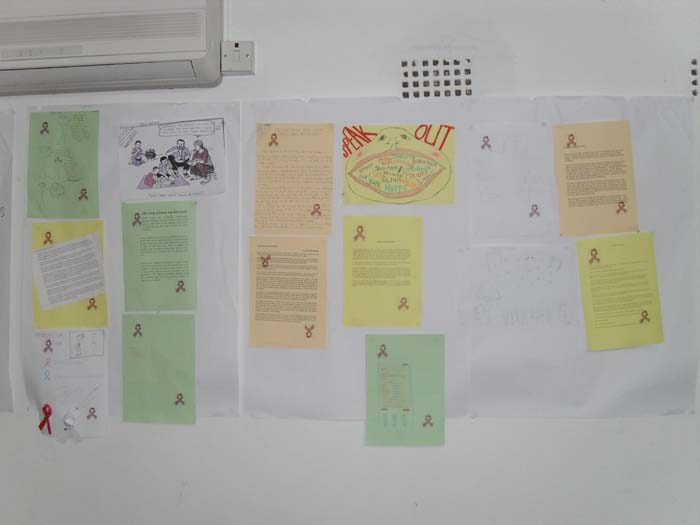
World AIDS Day articles and drawings by staff members stand as
At the end of the presentations, they were teary eyes around the table and not much to say. We were all soaked with different emotions at the reality of just how devastating HIV had been in each one of our lives. Although it had clearly affected us in different ways, the impact was the same.

However, while the session may have been emotional, a quiet time of reflection was exactly what the team needed. For people whose daily work involves dealing with different issues relating to health including HIV, it is very easy for one to get caught up in work and neglect ones family and even themselves.

Perhaps timely, the session was followed by another South African documentary, ‘The Moment.’ The funny and honest film features, people from different backgrounds who share their most personal thoughts about courtship and sexual behaviour. The discussion tackles the process of sex from the “moment you meet, the moment you connect, the moment you seduce, the moment you kiss, the moment you take your clothes off and the moment before penetration.” Unfortunately, for all the participants in the documentary, the “moment to wear a condom never came.”

By the time we left Alliance Zambia premises and all drove in a convoy to Cheshire Homes, we had all relaxed and looked forward to what lay ahead. Although we found the children had gone marching to commemorate World Disability Day, the sister in-charge gave the team a tour of the facility before presenting clothing and baby caps to the care-givers.

Sister Marjorie, thanked the team for the donation making note that while the centre has received donations in the past, none were ever directed for staff, something she greatly appreciated.

Thankfully, the children arrived back in time for us to say hello. As we drove back to Alliance Zambia, I remember thinking just what a privilege it was for me to work with such an amazing group of people.PYM

Tuesday, December 4, 2012

Mungule women hatch new family plan for 'overbearing' hubbies

By Meluse Kapatamoyo

When couples get married, they become one, literally meaning all decisions and plans made are done jointly and in consultation with each other. But, when it comes to matters of family planning, the women of Mungule have no say. The men plan the family and choose the kind of birth control method to use disregarding the women.

There is a case of a young woman in Mungule who had three children within a space of five years. She bore her first child at age 16. Before she turned 18 she had her second and the third one came when she was celebrating her 21st birthday.

There are a lot other women who have similar situations of having that many unplanned children in the area.

During Alliance Zambia’s community dialogue at Mungule Rural Health Care, mothers aged between 17 and 43 testified that despite being the ones that carry the pregnancy, the decision of when to get pregnant was made by the husbands - many of whom unfortunately, have not embraced the different birth control methods available at health centres.

In areas like Mungule, the old belief that a man is defined by the number of children he has, still very much exists. Even when the man agrees to use condoms during the first few months after delivery, the rubber is put aside as soon as the child turns a year old. Thus many women find themselves pregnant soon after, as their spouses do not allow them to be on birth control.


One woman shared her that: “my husband demanded I get pregnant soon after my baby turned six months old. He said by the time I delivered, the child would be old enough to have a sibling. I insisted that we needed to wait until the baby was at least two years. He refused and threatened me with divorce. I got pregnant two months later and delivered my second child when my first born was 1 year 7 months.”

The consensus among the group was that given a choice, women would have preferred to have waited at least three years to allow for the proper growth of their children before getting pregnant again. They worried about their inability to provide their children with good nutrition and a good education.

Having realised the benefits of child spacing on the family, especially on the children, the women have taken a more aggressive approach to prevent further pregnancies.

They are now using different and discreet birth control methods without the knowledge of their spouses. Injectables, are quiet popular. Unlike contraceptive pills, the mothers say the possibility of the man finding out about the injections was zero.

One woman explained that for some who prefer contraceptive pills, they have devised interesting ways of ensuring that the tablets are well hidden from their husbands.

“I have dug a hole outside in the field. They are wrapped in a plastic bag just in case it rains. Sometimes it’s difficult to take the pill especially when he (husband) decides to stay home but most times I take them freely. I plan on telling him when the time is right. Maybe if he realises that I am not getting pregnant, he might accept that the six children we have are enough. Right now, we are struggling to feed, clothe and educate them,” she said.

And in Malupande Village, located about 4 kilometres from Mungule Rural Health Centre, the story was the same. The women, too, have had to find clever ways of keeping their husbands from finding out that they were using birth control.

They hide the contraceptive pills under rocks or with neighbours. Those afraid of being seen at the health centre, rely on a traditional herb called Nkankalamba, also popularly known as Kalulalula. The herb is soaked in water and the juice consumed soon after sexual intercourse.

While some women are willing to go to extremes to ensure they do not become pregnant, others have avoided using family planning methods because of the belief that they cause various tumours and diseases such as cancer. Others simply believe family planning methods as advocated at health centres do not work. Some of the mothers revealed having friends who got pregnant despite being on birth control.

But Isaac Phiri the facilitator of the dialogues from Bwafwano Integrated Services (BISO) advised the women to seek medical advice from trained health experts at clinics and also Neighbourhood Health Committees (NHCs).

He assured mothers that none of the family planning methods available at health centres caused tumours or different types of cancers as was the fear by some women.

Mr Phiri also warned the women against burying contraceptive pills in the ground as the temperature in the ground was likely to interfere with the effectiveness of the pill.

The community dialogue in Mungule was organised by the Alliance for Community Action on HIV and AIDS (Alliance Zambia), with support from Save the Children Sweden (SCS), under the project, “A Concern for All: Maternal and Child Health Interventions Towards 2015.” PYM

Monday, October 22, 2012

Neighbourhood health committees out to reduce maternal mortality

By MELUSE KAPATAMOYO

The day is September 25, 2012 and I am at Chaisa Health Centre to be part of a Focus Group Discussion (FGD) on Maternal and Child Health being held by Alliance for Community Action on HIV and AIDS in Zambia (Alliance Zambia), with Neighbourhood Health Committees (NHCs).

Despite it being a windy day, as soon as I step out of the vehicle, am greeted by a strong stench emanating from a nearby sewer. Fortunately my attention immediately shifts to a large crowd of women and children attending an Under-Five Clinic. What is even more striking is that the majority of these mothers are still children themselves.

Before my brain can process the situation and begin to ask the necessary questions, my focus is drawn to a screaming baby. I curiously watch as the young mother struggles to calm the child down.  Looking somewhat embarrassed and irritated by the child’s screaming, she starts to remove the baby’s clothing, signaling that perhaps the September heat could be the reason for her Childs discomfort.

But that doesn’t calm the child down, forcing one elderly woman to ask if the child is sick. Her response, ‘This is the way she cries. She will stop on her own. I am used to it.’  The woman suggests that she should perhaps try and breast feed the baby. Having drawn everyone’s attention already, the young mother reluctantly gets ready to feed but the young mother lamentably struggles to hold on to the breast and at the same time hold on to the child. It is clear that she is yet to grasp the art of breast feeding. 

Luckily for her, she gets a free lesson from the elderly woman who teaches her how to hold the baby’s head comfortably, while holding on to the breast to prevent chocking. In just a few minutes, the child’s screaming is replaced by the normal noise of other children, running around the clinic compound as the crying baby falls asleep.

“That is a daily occurrence around here. We have children, having children. And when these children have children, they have no idea of what it takes to be a mother. The situation is made worse because most of them miss out on ante-natal where they can be taught some of these things such as the importance of nutrition. Instead of attending ante-natal the girls try by all means to conceal their pregnancies,” says one NHC member when I shared the story of the young mother and her breast-feeding dilemma during the Focus Group Discussion. 

“About two months ago, an 18 year old girl gave birth just outside the clinic. She had kept the pregnancy hidden until she went into labour, by the time they got here, it was too late. They couldn’t get her inside the clinic. It’s a difficult situation, we are dealing with mothers who not long after delivery start to live the child in the care of younger siblings or old grandparents, depriving the baby of breast milk and motherly care,” added another NHC member. 

According to the NHCs, as high as the turn-up of mothers who bring their children for under-five clinic at Chaisa Health Centre may seem, the number of women that stay away was equally high.  The clinic covers three catchment areas; Marapodi, Chaisa and Mandevu.

Some of the reasons they absconded from accessing health care services at the clinic included; long queues caused by lack of adequate staff at the health centre and lack of family planning knowledge, which often leads to some mothers getting pregnant soon after delivery, making it difficult for them to live home and take all their children for under-five clinic. 

However, some women find taking a malnourished child to the clinic embarrassing. Instead they choose to keep the child hidden even from neighbours than admit they are unable to provide a proper diet for it. This is despite having knowing that through NHCs the clinic offers free nutritional supplements for malnourished children and also free cooking lessons.

While some of these challenges are being addressed by NHC’s in the area, others are beyond the committee’s capabilities and can only be handled by relevant authorities such as councilors, Member of Parliament (MPs), Ministers/Ministries.

Realising the important roles that NHC’s play in communities and the urgent need for these maternal health challenges to be addressed by authorities, a suggestion was born by Alliance Zambia, with support from Save the Children Sweden (SCS), to hold an  Advocacy training on Maternal and Child Health for Mungule and Chaisa NHCs. 

Together, and in collaboration with health centres in Mungule (Chibombo) and Mandevu (Lusaka) the two organisations are implementing a project that will see a two third reduction in morbidity rates for children under five years old in Zambia by 2014. The project is also promoting safe motherhood and is contributing towards improving maternal health in Zambia by 2014 and reducing maternal mortality by three quarters, thereby contributing to Millennium Development Goals (MDGs) 4 and 5.  

The two day training was held in Lusaka and attended by 10 participants from Chaisa and Mungule, an area where maternal health challenges are rampant and where two Focus Group Discussions were held prior to the training.  Each NHC was represented at the training by five participants.

Key points in the training included brainstorming major health challenges affecting women and under five children in Mungule and Chaisa and then depending on the particular issue, identifying targets they could advocate their problem to.

Although both areas faced similar problems, they chose different issues as the ones needing advocacy.


NHC Members Stanely Banda (R) and Leonard Mwewa during the
Alliance Zambia training.

“For a long time we have had major issues in our communities needing urgent and serious attention from our leaders, but didn’t know how to approach them. It was difficult to find ways of tackling these issues. The training has indeed opened my eyes to the many different methods we can use to air our views and most importantly get the attention of our leaders,” said Chaisa NHC member, Stanley Banda, enthusiastically, at the end of the training.

And Mungule’s Catherine Himoonga said, “Advocacy used to be such a strange and complicated word to me, now I understand it and how to go about it. I can’t claim to be an expert but it’s good that the team from Alliance Zambia have committed themselves to be available when we need help. We have always been silent and do nothing when things go wrong in our community but with this training, we now have an idea of how to go about it.” PYM. 

Friday, September 14, 2012

Measles Campaign draws thousands

     ...as men get involved

BY MELUSE KAPATAMOYO


Children queue up to receive the measles vaccine
 
With just a day to go, Zambia’s five day countrywide Measles Campaign has received overwhelming response in areas like Chazanga compound where 5025 children were vaccinated at Bwafwano Integrated Services Organisation (BISO) Health Centre during the first three days.

Despite some parents complaining of having to wait in the queue for many hours in the heat, by end of day on Wednesday, a total of 1,470 children had been vaccinated. The campaign runs from 10-15th September 2012 across the country.

A visit to the area by Alliance for Community Action on HIV and AIDS (Alliance Zambia) on Wednesday (September 9, 2012) found hundreds of children in queues accompanied by elders who included mothers, fathers and grandparents.

Siblings older than 15 years of age accompanied their younger brothers and sisters, and "shared" their pain of the measles prick.

Alliance Zambia took the opportunity to sensitise the community through drama on the need to take children to health facilities for a healthy living and also distributed baby caps donated by Save the Children Sweden (SCS).

“The response here has been overwhelming because most of the children in this area are under our programmes. The mothers are under our PMTCT (Prevention of Mother to Child Transmission) programme and as a result they prefer coming here.


BISO Executive Director Beatrice Chola
"We have been urging parents to take their children to other health posts for vaccination but that is not something they want to hear,” explained BISO Executive Director, Beatrice Chola.

She said because of the awareness campaigns on the PMTCT programme held in partnership with Alliance Zambia in 2011, Bwafwano has seen an increase in male involvement on maternal and child health issues.
                                                  
“The programme has really come up with good results. Men in this area are very much involved concerning PMTCT, immunisation of children and escorting their wives for ante-natal clinics,” said Mrs Chola.

For men like Joseph Zulu, father of three year old Naomi, escorting his wife and children to receive medical attention is a non debatable issue.


Naomi receives the measles vaccine
 He said having been raised by a grandmother, being around women and helping with household chores or trips to the clinic were normal to him.

“My wife and I are partners. Anything that involves her involves me. It is my duty to make life easier for her and vice-versa and bringing our child to the clinic while she attends to household chores is my way of supporting her," said Zulu.


Joseph with his niece Alice
 Two of Zulu's nieces were at his house on a visit from Pemba and he made sure that they too got vaccinated.

BISO situated in Chazanga, is a non-governmental organisation, established in 1996 during the time when high levels of Tuberculosis, HIV patients and vulnerable children were at an all time high.

The organisation which houses the health centre and a community school within its premises has a strong stamp in the community, and hence has had to deal with a high number of children turning up for vaccination than any other health centre in the area.

Bwafwano which started as a home based care with only 27 patients now has 15, 000 patients under the home based care programme. Other programmes include PMTCT, Voluntary Counseling and Testing, Sexual Reproductive Health and skills training. 

Chazanga catchment area has a population of 103, 000 people of low income with only one government clinic in the area. PYM

HIV stigma curtailing positive living


By MELUSE KAPATAMOYO

Being found HIV positive and choosing to live positively can be an easy thing to do, what makes it hard is living in a community that constantly reminds you that your health is in danger. 

At five months pregnant, Susan discovered that she was HIV positive and since then life has not been easy for her.

"I am a strong person mentally but the things that people say when I tell them about my status are difficult to take. Sometimes it takes God to get through a day,” says 26 year old Susan of Chiyuni village in Kembe, Chibombo district.

A housewife and mother of one, she started getting sick when she was four months pregnant. She was initially treated for malaria, but her condition continued worsening.

Chitanda Rural Health Center
Nursing staff at Chitanda Rural Health Centre later referred her to Liteta Hospital, 90km from Chitanda, where a pneumonia test came out positive. 

Despite commencing treatment for pneumonia, the discomfort and pain in her entire body persisted.

After the pneumonia treatment, Susan and her husband were then tested for HIV and both were positive.

“I had heard about HIV before but never thought I could get the disease (virus) so yes I was shocked. After counseling, we were put on medication and I got better. I was determined to give birth to a healthy baby so HIV became just like any other disease.”

While some friends and family members have distanced themselves from Susan and her husband, others ask how she contracted the virus, as well as how she intends to live the rest of her life with HIV.

“I have been asked a lot of demeaning questions most of which insinuate that I was promiscuous. But the worst statement I have received and this I have had people say to me more than once was ‘If I were you and I found I was HIV positive, I would kill myself’," explains Susan.

She says while such statements can hurt like a knife to the heart, however she continues to live positively and does not hide her status. For Susan, raising her daughter is much more of a challenge and a concern than what people have to say about her condition.

Although her 14months old baby is HIV negative, her health from birth has been greatly affected by the lack of proper nutrition. She was forced to immediately put her child on supplementary feeding soon after delivery when her breasts failed to produce adequate milk for the baby.

Months later, Susan said she switched to Super Shake (Maheu), a much cheaper option compared to a tin of formulae which costs about K30, 000 and lasts less than a week.

She is worried that her daughter may suffer from malnutrition and is eager to get knowledge on what other options are available for a child who is basically living on Super Shake instead of breast feeding as recommended by the World Health Organisation (WHO) for children upto two years or more.

For Susan and hundreds of mothers in the Kembe area, the sensitization on stigma, nutrition and other health issues that they desperately need may not be too far away.

Alliance for Community Action on HIV and AIDS (Alliance Zambia) with support from Save the Children Sweden (SCS) is looking into starting a project to address issues on Maternal and Child Health. The organisation was recently in Kembe to identify maternal health concerns and also identify key stakeholders that can be engaged on the SCS project. The visiting group also conducted a community mapping exercise of maternal health services in the area which included a visit to Chitanda Rural Health Center.

The SCS project will work towards contributing to Millennium Development Goals (MDGs) 4 and 5; to reduce mortality and morbidity rates for children Under Five years old in Zambia by 2014 by two thirds and to promote safe motherhood, improve maternal health in Zambia by 2014 and reduce maternal mortality by three quarters respectively.

Alliance Zambia Programmes Manager, Shupe Makashinyi, said that one of the many activities of the project which is already underway in the populated area of Mandevu in Lusaka includes sensitization on nutrition which is key to maintaining the good health of a mother and child.

The Smart- Care System may also be strengthened should the project go ahead in the area.

“We have already identified gaps in the Smart Care System. We have discovered that there is only one computer at Chitanda Rural Health Clinic (which has 472 women on ART).

To address this problem we would consider bringing in another computer to hasten the process of filing information. By sorting out this problem, we are not only helping out the healthcare providers but families because when a mother goes for ante-natal she will now not spend too much time at the clinic. She will be attended to in record time and return home quickly to attend to other duties” explained Mrs Makashinyi.

Operating as a non-governmental organisation, Alliance Zambia established in 2008, has been affiliated to the International HIV/AIDS Alliance since 1999. The organisation works in tandem with National AIDS Strategic Framework providing technical and financial support to Community Based Organisations (CBOs) and other Non-Governmental Organisations (NGOs). 

It implements capacity-building activities which strengthen community based HIV/AIDS Prevention, Care and Support responses including Sexual Reproductive Health (SRH), Maternal, Neo-natal and Child Health (MNCH), Orphans and Vulnerable Children (OVC), and anti-stigma and discrimination programmes. 

The organisation, in collaboration with the ministries of Health and Community Development Mother and Child Health, has been implementing healthcare programmes in Lusaka, Eastern, Southern and Copperbelt provinces.

If all goes according to plan, the Maternal and Child Health project will help people like Susan who seek information on nutrition and other services.

The Central Statistical Office puts the Kembe catchment area at 21, 977, but local officials say the number currently stands at 29, 000. PYM